
Buena Park Sources for Past Residents
A past-resident trail needs both ownership and household sources. The deed index establishes named parties to recorded interests. A city directory or reverse section can place a household at an address for a publication year. The federal census supplies household relationships at its enumeration date. Permits date physical change and identify project participants. The coverage table keeps those roles separate.
| Source | Years It Covers | Where Held | What It Shows |
|---|---|---|---|
| Recorded-document index | Pre-1982 book/page conventions; 1982+ instrument convention | Orange County Clerk-Recorder | Parties, dates, types, copy reference |
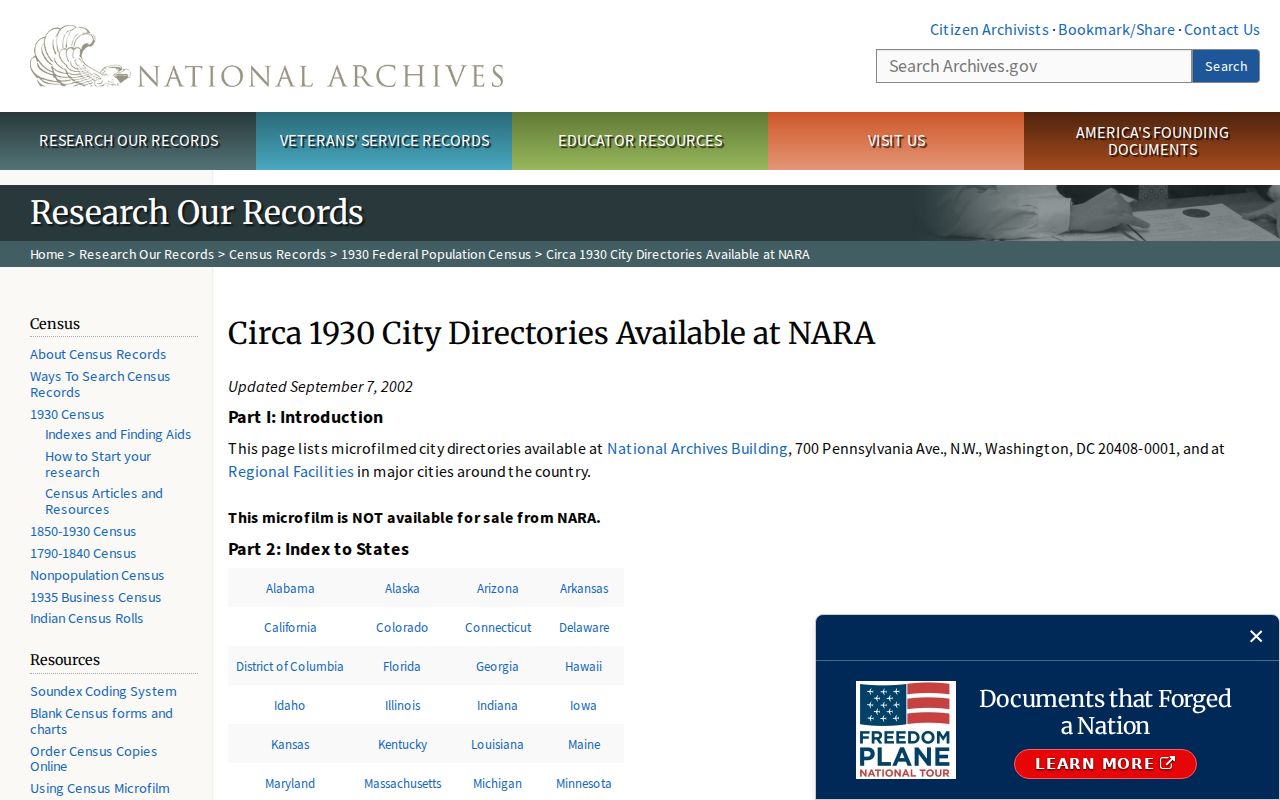
| Regional city directories | Verified 1926, 1928, 1929, 1931, 1932 dates | NARA and institutional microfilm | Names and address clues |
| Federal census | Public through 1950 in 2026 | NARA, library, genealogy institutions | Household membership at enumeration |
| City permits | Department and series specific | Buena Park city records | Project history and named participants |
| Probate and obituaries | Case or publication specific | Superior Court and archives | Death, heirs, representatives, moves |
Start with the source that matches the period. A modern address is easiest to anchor with the APN and deed chain. A pre-incorporation household needs county and regional titles. A death or inheritance question may end in probate or an obituary rather than a directory.
The National Archives city-directory inventory capture below is useful for the verified regional dates.
Start a Buena Park Address Timeline
Begin with the address as it exists today, but record more than the street line. Save the normalized GIS result, unit or building mark, APN, situs address, mailing address if shown, and legal description. Situs means the physical parcel. Mailing means where notices go. Legal description is the title anchor that can survive a change in street wording.
Buena Park's locator checks exact address points before centerline ranges and recognizes intersections, abbreviations, units, place names, reverse geocoding, and batch geocoding capped at 2,000 records. This helps distinguish a true address change from a spelling or range-match issue. The research located no verified citywide street-renumbering event, so no such event should be asserted as an explanation for a gap.
- APN
- The county assessor parcel identifier used to keep a land record tied to one parcel.
- Situs
- The physical address of the parcel.
- Legal description
- Recorded lot, block, tract, or metes-and-bounds wording.
- Address gap
- A break that may come from spelling, units, boundaries, publication, or missing coverage.
Note: Preserve both the original historical address and the modern normalized form before searching for previous residents.
Walk Back Through Buena Park Grantors
A title trail moves from the latest identified acquisition backward. Search the current party as a grantee, identify the seller or grantor, then search that earlier party as a grantee. Keep the APN or legal description beside each result. The chain proves recorded interests, not every person who lived at the property.
- Identify the parcel and latest available acquisition reference from the APN, assessor context, or a known deed.
- Search the Orange County Grantor-Grantee Index by party name, role, date band, and document type.
- Record the instrument number or the older book, page, and instrument references.
- Read the earlier seller as the next grantee and repeat the search backward.
- Compare the legal description after every transfer so two nearby parcels do not merge.
“Grantor” is the person or entity conveying an interest. “Grantee” receives it. A chain of title is the linked sequence of recorded transfers. The county's index is free, but the document image is obtained through a separate copy request.
The Orange County Grantor-Grantee Index is the place to identify the reference before ordering pages.
Order Buena Park Deed Images
The online recorder index does not provide deed images. After finding a document number, book and page, or other reference, use the Clerk-Recorder copy process. For pre-1982 documents, provide book, page, and instrument data when available. For 1982-forward documents, use the recording year plus six-digit instrument number. Staff will not conduct the grantor-grantee search by phone, mail, or counter.
Ordinary recorded-document copies are $1 per page, with $1 certification per document or map. The mail route uses a self-addressed stamped envelope and a check payable to the County of Orange, Orange County Clerk-Recorder. The copy form provides rows for document number, title or description, book, page, page totals, and regular or certified selection.
The county copy instructions show why the index hit and the official page order are separate steps.
The copy-request source is captured below for the previous-resident workflow.
Use the 1982 Buena Park Reference Change
The 1982 distinction is a note-taking hinge. Older documents are reached through book and page conventions, while newer entries use a year and six-digit instrument number. Both can belong to the same parcel chain. A search that stops because the format changed has stopped at an access transition, not necessarily at the end of the property history.
Orange County Archives conserved 640 original property-deed volumes dated 1889-1926 and 210 property-index volumes dated 1889-1953. Those holdings offer a concrete pre-digital fallback. If the online index gives no useful modern route, use the archive finding aid, the counter, or a defined copy request rather than guessing at a missing year.
Note: Record the reference format beside every date so a later researcher can tell an old book-page search from a modern instrument search.
Buena Park Reverse Directories by Address
Reverse or criss-cross directories add the household layer that a deed chain cannot provide. A street section is arranged by address, so search the exact number and then read nearby numbers. Track apartment letters, initials, occupations, spouse marks, and “removed” or “deceased” notations. A missing entry can reflect publication lag or incomplete canvassing.
Verified regional directory dates for Buena Park include 1926, 1928, 1929, 1931, and 1932, but the source material does not prove that each year contains a complete reverse section. Ask the library or microfilm institution to confirm the actual volume before promising a page search. The city directory collections page owns the shelf details; this backward trail uses the entries to connect an address to a past household.
A directory entry is a publication-year clue. It should be paired with a deed, census, newspaper, probate, or obituary when identity or a move matters.
Pair Buena Park Directories and Census
The federal census supplies a household snapshot at an enumeration date. Under the 72-year rule, 1950 is the latest public federal schedule in 2026. A directory near 1930 can supply a street address, occupation, or spouse clue, while the 1930 census can test relationships and ages. Geography must follow the period because the future Buena Park area may be listed under a township, enumeration district, or neighboring postal place. Current demographic context belongs to the dated Census QuickFacts page, not to an old household inference.
- Normalize the old street name and locate the directory's community heading.
- Search the name-ordered entry and then the street-order section.
- Write down occupation, spouse, initials, address, and nearby household entries.
- Compare the closest open census and map the historical enumeration area.
- Use deeds, probate, or obituaries to explain a later move, death, or inheritance.
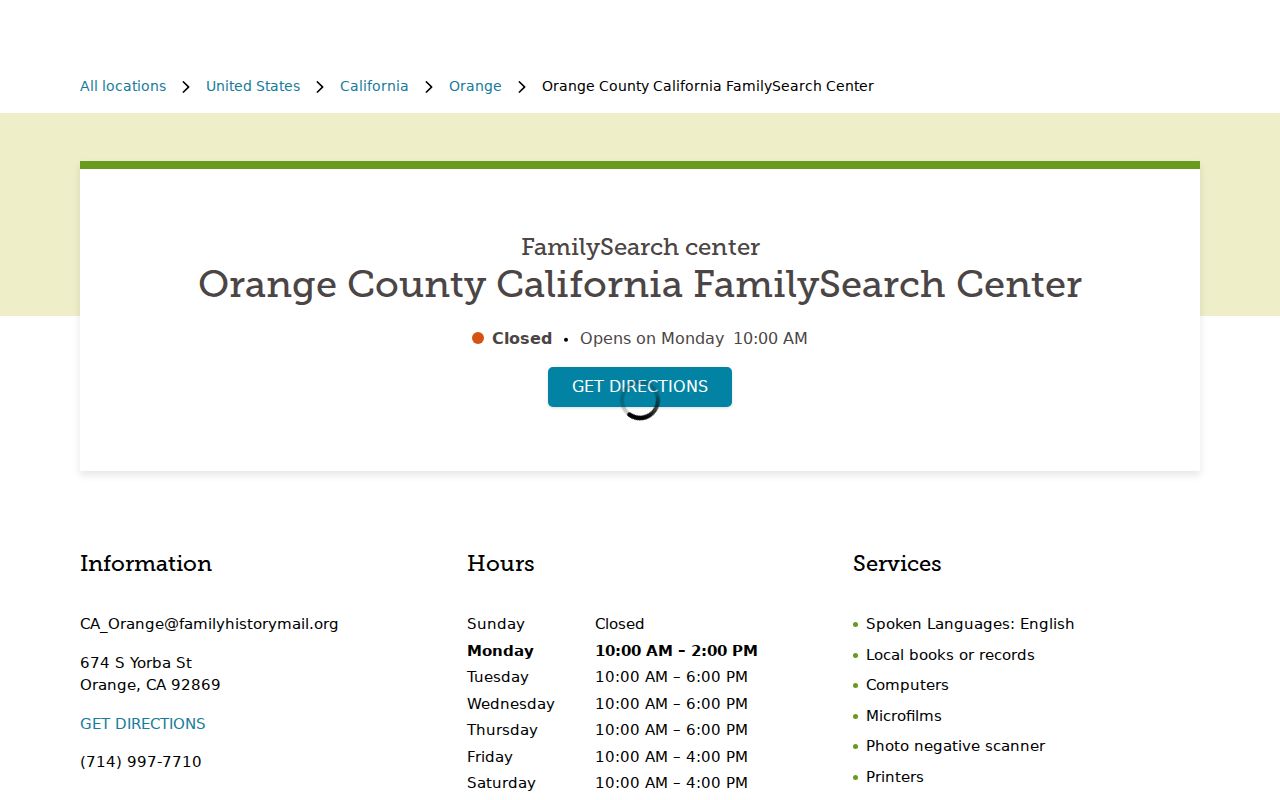
FamilySearch's national city and business directory collection spans roughly 1749-1990, though its page does not expose a Buena Park-specific run. The Orange California FamilySearch Center at 674 S. Yorba Street offers computers, local books, microfilm equipment, and scanners; confirm hours before visiting.
The Orange California FamilySearch Center source is captured below as a repository lead.
Buena Park Permits and House History
Building and planning permits can date a physical change and identify an applicant, contractor, owner, or project contact. They can explain why a directory address looks different after an addition, demolition, or rebuild. A permit participant is not automatically a prior occupant, so write the relationship precisely.
Request a defined address and date range from the responsible Buena Park department. Start with the city locator so the request uses a normalized address and parcel context. Then pair the project date with the deed chain and a directory year. This three-source comparison can separate a title transfer from a structural change or a household move.
Note: Permits describe work at a place; they do not serve as a complete prior-resident list.
Obituaries and Probate for Buena Park
Obituaries and probate files can close a previous-resident trail when a household member died, left an estate, or transferred property through an heir or representative. A probate case may identify a personal representative and filed notices. A deed may show an estate or trust transfer. A newspaper notice can add relatives or a former address, but each item has its own accuracy and access limits.
Search Orange County Superior Court probate routes, county archives, OC Public Libraries databases, and regional newspaper collections. Use the person's full name, address, occupation, and approximate date together. A prior address in an obituary is a historical clue, not a current contact instruction. Keep living people out of an unnecessary public narrative.
The Online Archive of California can help locate finding aids for Orange County and Buena Park collections. The archive search is a discovery route; request restrictions and box details from the holding institution.
Past Buena Park Households
Ownership and household history answer different questions. The deed chain can move backward through title parties. City directories and census schedules can show a household at a date. Permits can date the structure. Probate and obituaries can explain an exit or transfer. A credible account keeps those layers side by side instead of calling every named person a resident.
Previous residents research in Buena Park is appropriate for house history, genealogy, estate work, and personal curiosity. California Safe at Home protects eligible participants through substitute addresses and confidential voter registration. Older public records may remain, but protected information must not be recombined or used to track a living person.
Lawful use. Keep a past-resident trail narrow and respectful. Never use historical addresses, names, or family clues to stalk, harass, threaten, or intimidate anyone.
The best closing note names the source, year, identifier, and uncertainty. “Who lived here before” is a question answered in layers, not by one index hit.