
Where Buena Park City Directories Reside
Holdings explain why a Buena Park city directory search must lean on regional titles and single years. The National Archives' circa-1930 inventory names Orange County volumes that include Buena Park for 1926, 1929, and 1931. The Midwest Genealogy Center lists Orange County microfilm roll 0409528 under Buena Park for 1928 and 1932. No publisher appears in either source. Treat those five dates as anchors. They represent holdings on the shelf, not a complete publication run.
| Collection | Years | Where Held | Access |
|---|---|---|---|
| Orange County regional volumes | 1926, 1929, 1931 | National Archives inventory | Inspect the community heading |
| Orange County microfilm roll 0409528 | 1928, 1932 | Midwest Genealogy Center | Institutional microfilm access |
| Orange County Archives directories | Series-specific | Old Orange County Courthouse | Finding-aid and staff request |
| OC Public Libraries regional titles | Item-level run unconfirmed | Catalog, branches, reference service | Catalog and shelf verification |
| Whittier History Room collection | 1903-1977 collection | Whittier Public Library | Verify Buena Park volume by volume |
| FamilySearch U.S. collection | About 1749-1990 nationally | FamilySearch | Account or institution access may apply |
No title-by-title shelf list exists online. That gap shapes the search itself. Ask a librarian to try combinations such as Buena Park directory, Fullerton city directory, Anaheim city directory, telephone directory Orange County, cross directory, yearbook, and the street name.
Before Buena Park Was Incorporated
Buena Park grew from James A. Whitaker's 1887 land development and incorporated as a city in 1953. Anyone living there earlier appears in county, township, school, postal, church, newspaper, or regional-directory records. A search limited to the modern city name can miss a household. That household may sit under an older geographic label. Orange County itself was created in 1889 from Los Angeles County. Land and court research before that date may point to Los Angeles County. It may also point to an earlier system. Read every historical city directory with care. Keep the period's boundary, postal place, and community heading in mind. The entry's address and occupation help confirm the place is the future Buena Park area. Note: A pre-1953 address may be locally recognizable even when the directory files it under a county or neighboring-city heading.
Where Buena Park Directories Sit
Orange County Archives at the Old Orange County Courthouse is the official fallback for county material, historic property records, photographs, and directories. Hours run weekdays from 8:00 a.m. to 4:30 p.m., closed from noon to 1:00 p.m. Ask for a finding aid and an exact series there. A broad directory label does not guarantee every Buena Park year. OC Public Libraries offers catalog and reference access to licensed genealogy resources. Some databases require an OCPL card or in-library use, though. Anaheim Heritage Center is a nearby north-county repository worth checking for regional directories, maps, newspapers, photographs, and vertical files. The Anaheim Heritage Center collection page is a useful lead. It is not proof of any specific Buena Park volume. The Orange County Historical Society adds regional context. The Buena Park Library local-history page points to its Historical Images Archive and Historical Society. Confirm access before traveling. The main library is under renovation in 2026. The society's site serves as a lead only. A catalog check for an individual directory year still comes first.
The Buena Park Library local-history service is a natural first stop for catalog and archive questions tied to the residents directory.
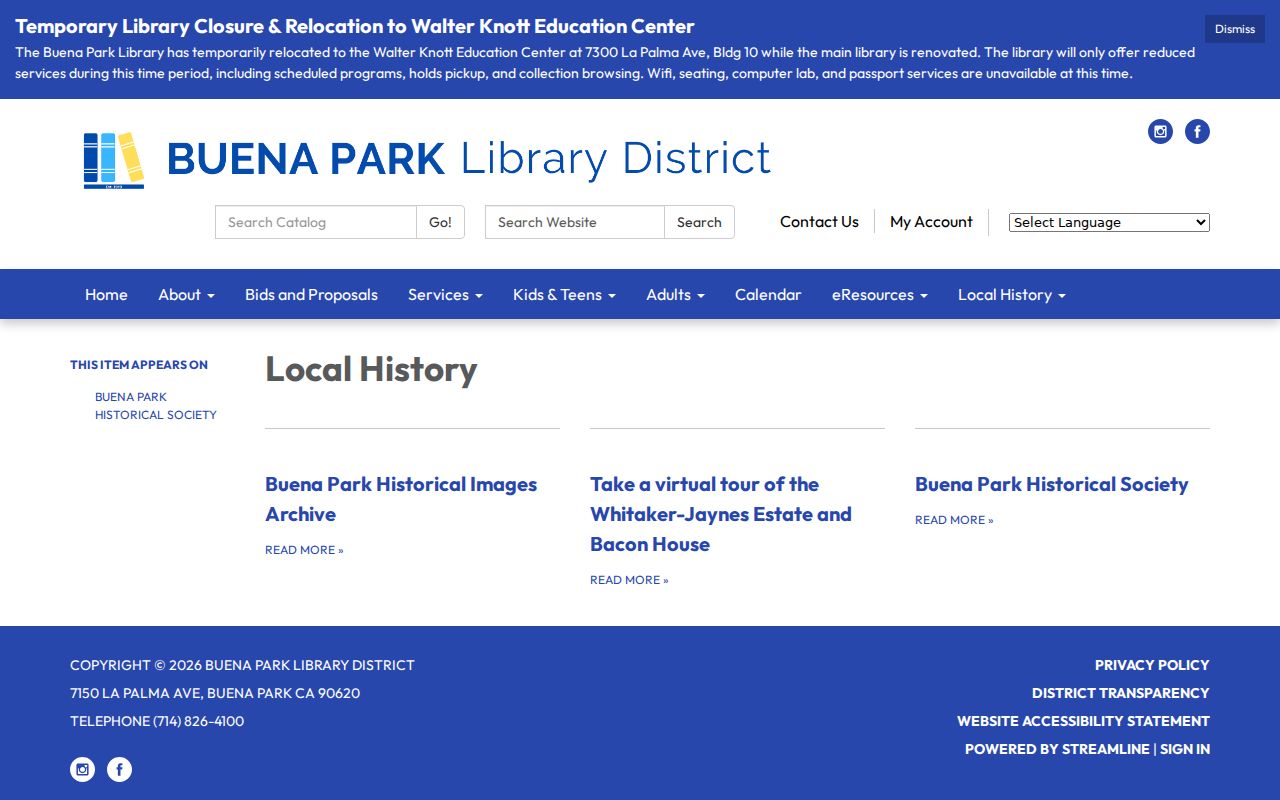
Treat the library's local-history offerings as a service lead. Then confirm the exact title, year, and access conditions before relying on any shelf reference.
Verified Buena Park Directory Years
The strongest year claims come from inventories that name both Orange County and Buena Park. The National Archives record for circa-1930 city directories identifies 1926, 1929, and 1931. The Midwest Genealogy Center microfilm listing identifies 1928 and 1932 on roll 0409528. Those dates do not establish a continuous annual series. No publisher is named. Use the years as anchors. A 1929 directory brackets a household near the 1930 census. The 1931 and 1932 volumes show whether an address or occupation persisted. A year may simply be missing. Test the library catalog, a regional title, newspapers, and the archive first. Do not assume the household disappeared.
| 1926 | Orange County volume listed by the National Archives inventory as including Buena Park. |
|---|---|
| 1928 | Orange County microfilm roll 0409528, identified by Midwest Genealogy Center. |
| 1929 | Orange County volume listed in the National Archives circa-1930 inventory. |
| 1931 | Orange County volume listed in the National Archives circa-1930 inventory. |
| 1932 | Orange County microfilm roll 0409528, identified by Midwest Genealogy Center. |
The National Archives city-directory inventory supplies the three regional dates. Check the microfilm listing at an institution before arranging any visit.
Read a Buena Park Directory Entry
A name-ordered entry in a city directory opens with a surname and given name or initial. Depending on the volume, it may add a spouse in parentheses, a widow marker, occupation, employer or business, home address, telephone, and an owner or renter notation. Abbreviations vary by publisher. Photograph or transcribe the key first. One stray mark can mislead.
| Name | Head of household, spouse notation, widow marker, or initials. |
|---|---|
| Occupation | Work or business clue that helps separate people with the same name. |
| Address | House number and street, sometimes with unit or boarder notation. |
| Telephone | Contact clue where that edition includes phone listings. |
| Cross-reference | Moved, removed, or deceased notation that needs corroboration. |
- Criss-cross directory
- A reverse section organized by street and house number instead of surname.
- Householder index
- A name or address aid that points to the main directory entry.
- Abbreviation key
- The volume's guide to short forms, symbols, and relationship marks.
- Community heading
- The place label used by the publisher, which may be broader than modern Buena Park.
Read both the name and street sections when available. A surname entry can suggest an address, while the reverse section shows how adjacent numbers were listed in the same edition.
Reverse Entries for Buena Park Addresses
The reverse section is where a city directory stops being a name book. It becomes an address tool. Look up the street first. Then find the house number and read the entries on either side of it. Note unit symbols, initials, and any mark such as removed or deceased. A gap can mean many things. Delayed publication, thin canvassing, an unlisted household, or a moved entry all produce blanks. Treat absence as a question rather than a confirmed vacancy.
For historical work, this criss-cross section is a bridge. It links a property trail to a household trail across a publication year. Pair the address you find with a deed. A census schedule, a newspaper item, a probate file, or a permit date can serve the same purpose. A modern address may still need parcel and legal-description work. Only then may it match an older street listing in the residents directory.
Note: A reverse entry places a household in one publication year. It says nothing about who occupies the address today.
Pair Buena Park Directories With Census
Federal census schedules open to the public after 72 years, under 44 U.S.C. section 2108. Right now the 1950 census is the latest schedule anyone can view. The 1960 count stays closed for a while longer. A Buena Park directory entry gives you an address or occupation close to the year you need, while the census adds household relationships as of its enumeration date. Use the two records side by side rather than as substitutes for each other.
- Normalize the historical street spelling and identify the community heading.
- Search the directory by surname, then check the street-order section for the address.
- Record occupation, spouse, initials, and nearby entries before leaving the volume.
- Use the nearest open census to test household relationships and age bands.
- Bridge a move, death, or inheritance with a deed, obituary, or probate record.
Agreement is the test. When an address, occupation, and spouse all line up across the 1929 and 1931 directories, the 1930 household match grows much stronger. A conflict means the opposite. Check the abbreviation key and community heading before assuming two same-name people are one.
| Era marker | What it contributes |
|---|---|
| 1929 directory | Near-year address, occupation, spouse or street entry. |
| 1930 census context | Household relationships at the enumeration date, subject to geography. |
| 1931 directory | Continuation or change in address and listed household clues. |
| 1950 census | Latest public federal schedule as of 2026. |
Buena Park Library's Local-History Trail
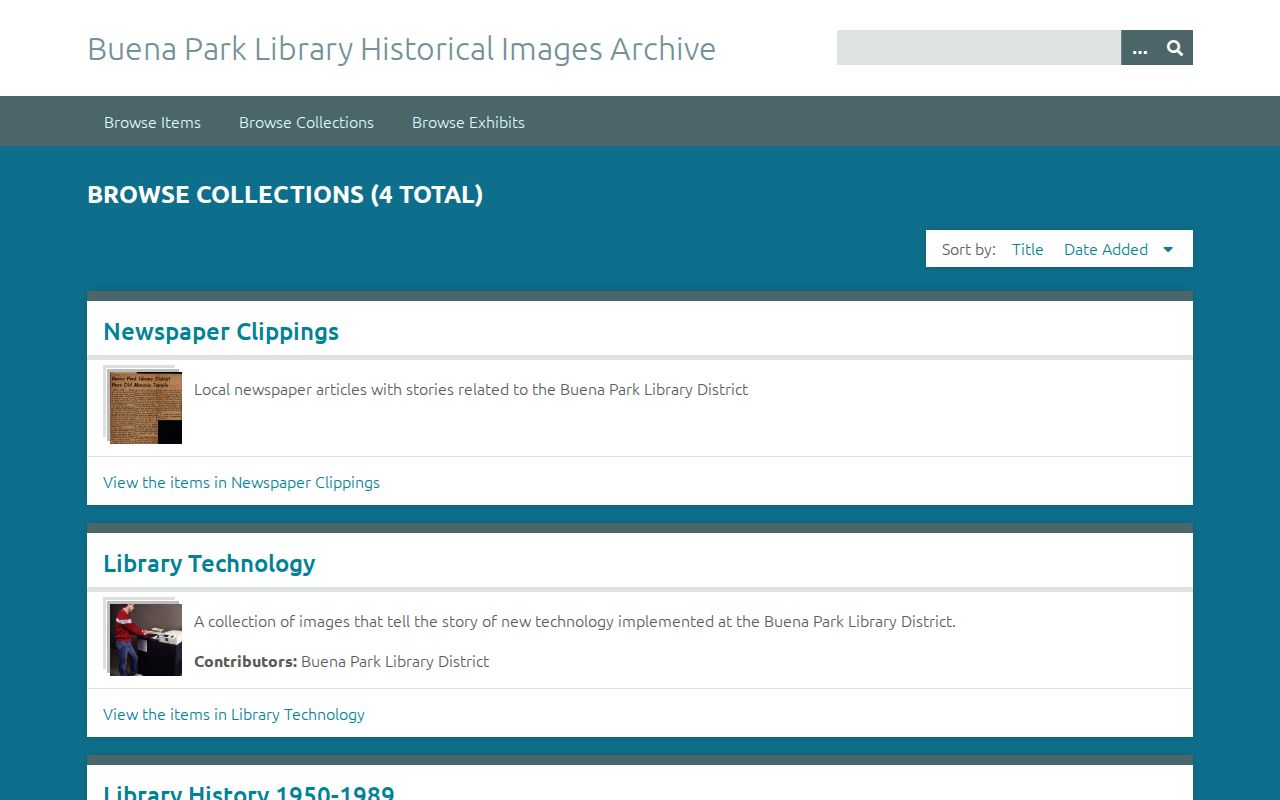
Buena Park Library's local-history page links to an Omeka Historical Images Archive and the local Historical Society. The archive supports keyword, Boolean, exact-match, item, file, and collection searches, along with browse and sort controls. Verified collections include newspaper clippings, library technology, and library history for 1900-1949 and 1950-1989.
Hyperlocal image records place Lily Creamery as Buena Park's first industry and first library site around 1900, identify the W. D. Hasson residence at 7611 10th Street as a book-storage site after 1907, and note temporary and later library locations near the Southern Pacific depot, Grand Avenue, Court Street, and a WPA-funded building. These clues can turn a directory search into a local-history search, but the image record still needs its own citation.
The Buena Park Historical Images Archive screenshot below shows the digital collection route. The main library is closed for renovation as of June 15, 2026, with reduced service at Walter Knott Education Center, so confirm local-history access before traveling.
Trace Family History in Buena Park Directories
Every family trail starts small. Begin with one known name, address, or relative in the Buena Park residents directory, and expand only when a new source adds a matching clue. The city directory supplies a publication-year snapshot of the household. Census schedules then test the relationships. Deeds and probate files connect land and inheritance, while obituaries can explain a departure or name relatives the directory never listed. That division of labor keeps the historical city directory useful without asking it to prove more than it records.
- Choose a verified year and write down the volume title, community heading, page, and entry wording.
- Follow the name across the next verified year while noting address, occupation, spouse, and abbreviations.
- Read the reverse section for the same address and nearby numbers.
- Compare the nearest open census and note differences in household membership or geography.
- Close the trail with a deed, obituary, probate file, archive item, or later directory.
Plan around the renovation. The current Buena Park Library service notice matters for anyone scheduling a shelf visit. A digital archive, catalog request, or institutional microfilm reader may be the smarter first stop in the meantime.
A name that vanishes from the directory deserves a method. Test four explanations in order: moved, deceased, unlisted, and publication gap. A missing entry is a prompt for the next record. It is never a conclusion on its own.
Tract Names in Buena Park Directories
Buena Park's official Neighborhood Communities layer names areas that carry no formal status. Presidents Tract, Generals Tract, Lakeside, and University Gables are among them. Those labels give a researcher extra handles. They can unlock newspapers, permits, photographs, and directory references when a street name alone comes up empty. Remember what they are, though: development and tract geography, not association membership lists.
Put a tract name beside the street and year. A Buena Park directory may use a community heading shaped by its publisher's coverage. The city GIS layer reflects the current map. Used together, the two can connect a historical phrase to a modern location. They do so without pretending the boundaries ever matched exactly.
Note: When a directory entry sits outside its expected heading, search the historical community label and the modern city name both.